Sunday, August 20, 2006

Monday, August 14 Varanasi, People-Watching, Smoking with Sadhus, Train Delays

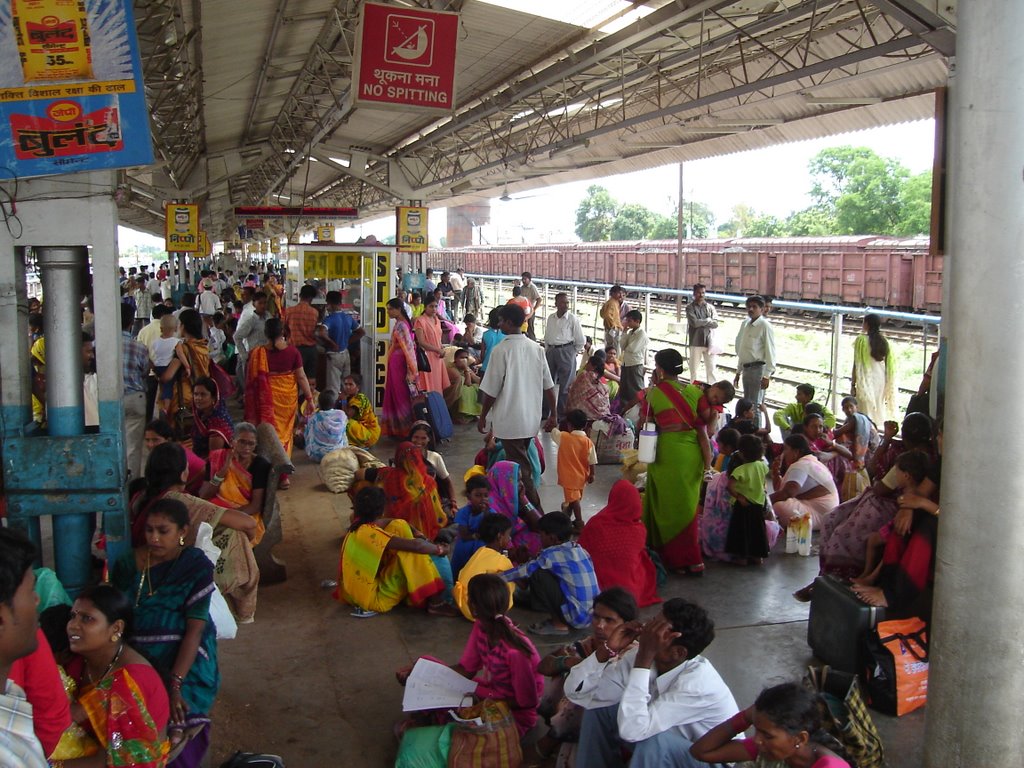
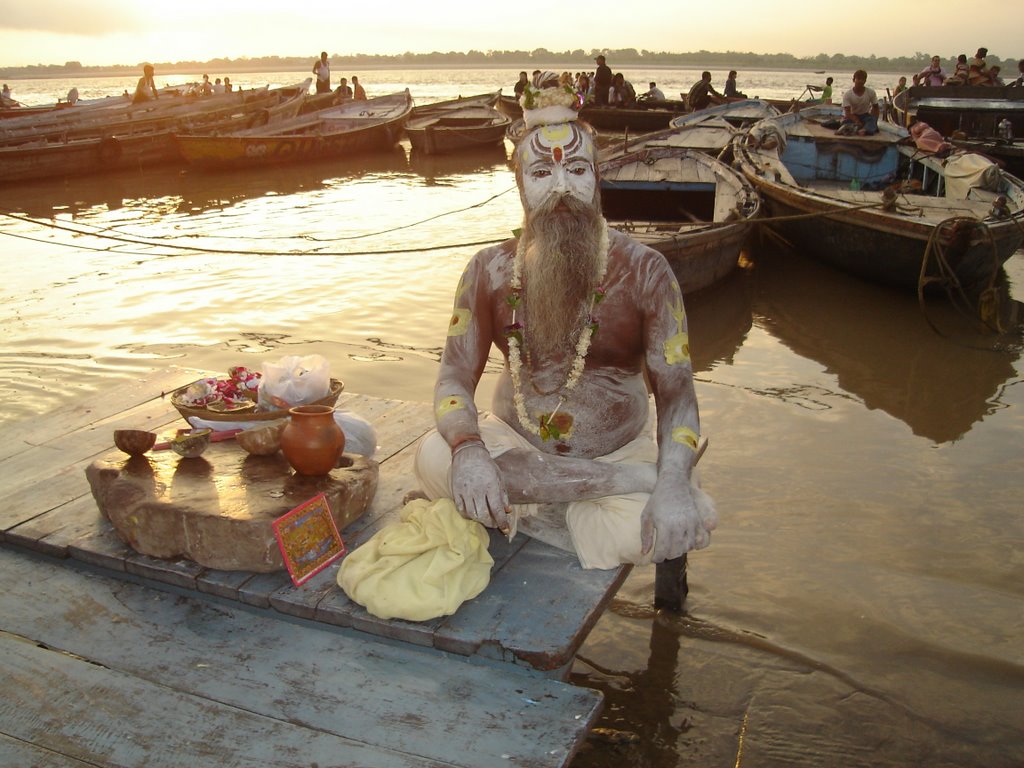
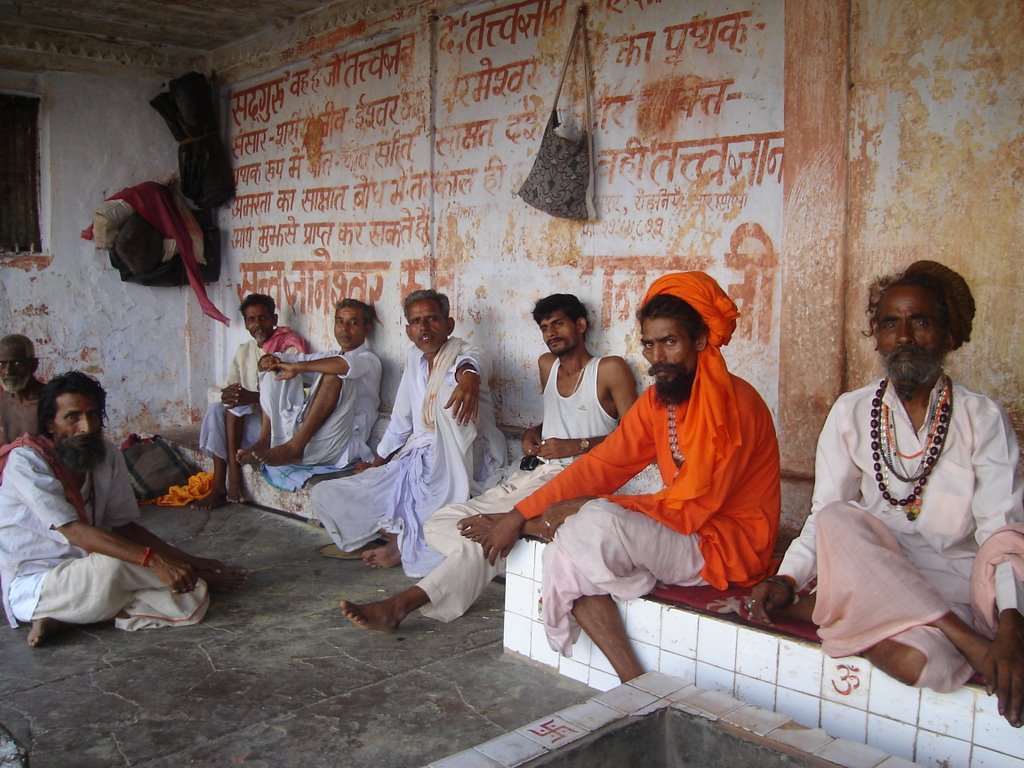
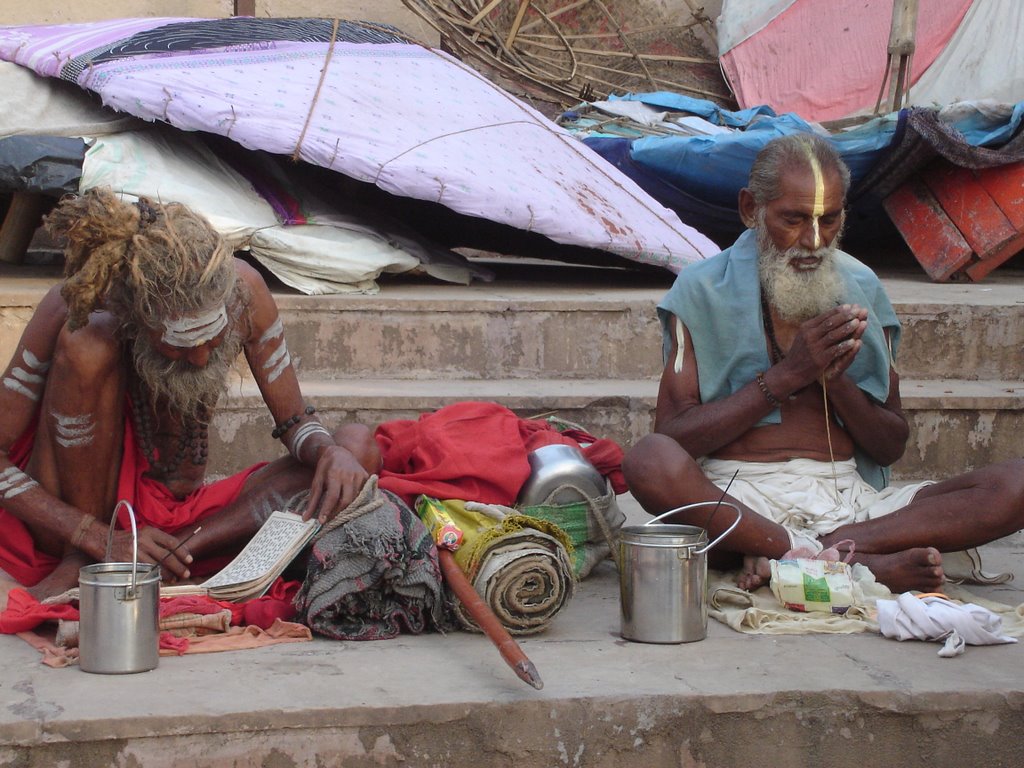
I woke up in a sweat from no electricity. Literally four seconds after I stood up out of bed the power and fan came back on. Of course. I went down to Dasaswamedh Ghat to people-watch. I took a picture with a chalk-covered naked sadhu, whose profession it was to pose for tourists for money. He gave me a bindi and a blessing. Everyone was outside; people young and old, many of them coming before a day of work or prayer, the Ganges purifying them. Priests dressed in white cloths and horizontal lines on their foreheads blessed everyday Hindus with a bindi and chant. People sold and offered prasad, rang bells at the Shiva temple, and watched their children run around the steps. Boys shaved all the hair, except for a little tail, off mourning men in white loincloths on the steps. Sadhus sat around, smoking and reciting prayers. I took a walk through the Old City north towards Manikarnika Ghat, the main burning ghat. Until only recently it was only open to Hindus. Non-Hindus still cannot be cremated here. It remains the most auspicious place for a Hindu to be cremated. It had firewood everywhere, and many viewing balconies. I was invited to watch from inside a hospital, where the elderly, lepers, and other sickly people await death. They are waiting to die in Varanasi so that they will gain moksha. A creepy dom with a glass eye explained the cremation grounds to me. Mother Teresa helped the hospital, and opened it up for non-Hindus to view the grounds. This decrepit old woman hobbled over and the dom prayed to her like she was a goddess. Then she blessed me. The dom explained how guests are asked to contribute money to pay for cremation wood for those who can’t afford it themselves. This is supposed to bring good karma to the donor. The two of them had me literally blocked off in a small corner, while a crowd of Indians looked on at us. They were both looking at me deeply with their bloodcurdling piercing eyes. The pathetic wrinkly woman kept chanting and touching my head. I told him I already donated to Harishchandra Ghat, so I had no obligation. Then they appealed to the spiritual, saying I wouldn’t have good karma or blessing if I refused to give. I offered 10 Rs, which they denied because they only want donations in denominations of 150 Rs “for cremation wood”. So, on the verge of exploding with a primal, furious, rage, I reluctantly took out 150 Rs and threw the bills in her face. I marched out of that building cursing incessantly. Why this makes me angry: 1) I’m tired of dealing with touts in the first place, 2) the money does not go to the hospital, 3) even if it does, I’m not paying for some old man’s hospital bill and room and board and funeral ceremony while most Indians can’t even afford to get to Varanasi, 4) There is no way to say no; who wants to risk having bad karma or a Hindu curse being placed upon them?, and 5) I am cheap. I walked through the Old City, snapping at hawkers offering to take me on their boats or to their shops. I was in a horrible mood, and was extremely upset, which again, only happens on rare occasions. I walked over to Scindia Ghat, which is an old temple that has collapsed and fallen into the river. I walked through the shops, and decided to buy god posters because what better place to get them than in Hinduism’s holiest city. I ended up spending a lot of money, but it was worth it because I bought an endless supply of artistic pictures and postcards depicting Shiva, Parvati, Ganesh, Ram, Sita, Krishna, Radha, Lakshmi, Saraswati, Hanuman, Kali, and Durga. After this I went to lunch at a small quiet restaurant, and the guy talked to me about his sexual accomplishments, which was awkward. I don’t know how accurate this was, however, since he mentioned that he had been with 30 different girls before. I went back to Dasaswamedh for the last time, and sat down with a group of eight sadhus, all wearing white kurta, saffron robes, or orange cloths. They were smoking hashish out of this tiny little pipe (which was literally just a pipe, a cylindrical hole). They offered me a hit, and being in the holiest place in Hinduism with a bunch of holy renunciants I had to accept, and took a big hit, which burned my lungs. We talked for a while about their organization of sadhus that come to this ghat to stay however long they want. Then I had to catch my train. I was late, and had to run to my hotel to catch a motor rickshaw to the train station. When I got there, there was an announcement that my train was two hours late. So I sat in the waiting room until I finished my second book. Then I went down to the platforms, only to get told again by the automated voice that the train was now delayed another hour. So I continued to wait, listening to some arrogant Canadian tourist (who said he was glad he was not American because Americans are crazy; actually, I agree with that, but please, if it wasn’t for America Canada would be nothing except snow, beavers, and maple trees). I talked to a Japanese tourist for a while before the train finally showed up four hours after its scheduled departure. It was a sleeper to Gaya in Bihar.
Sunday, August 13 Varanasi Cruise, Bathing in Ganges...again, Touts, Ceremony
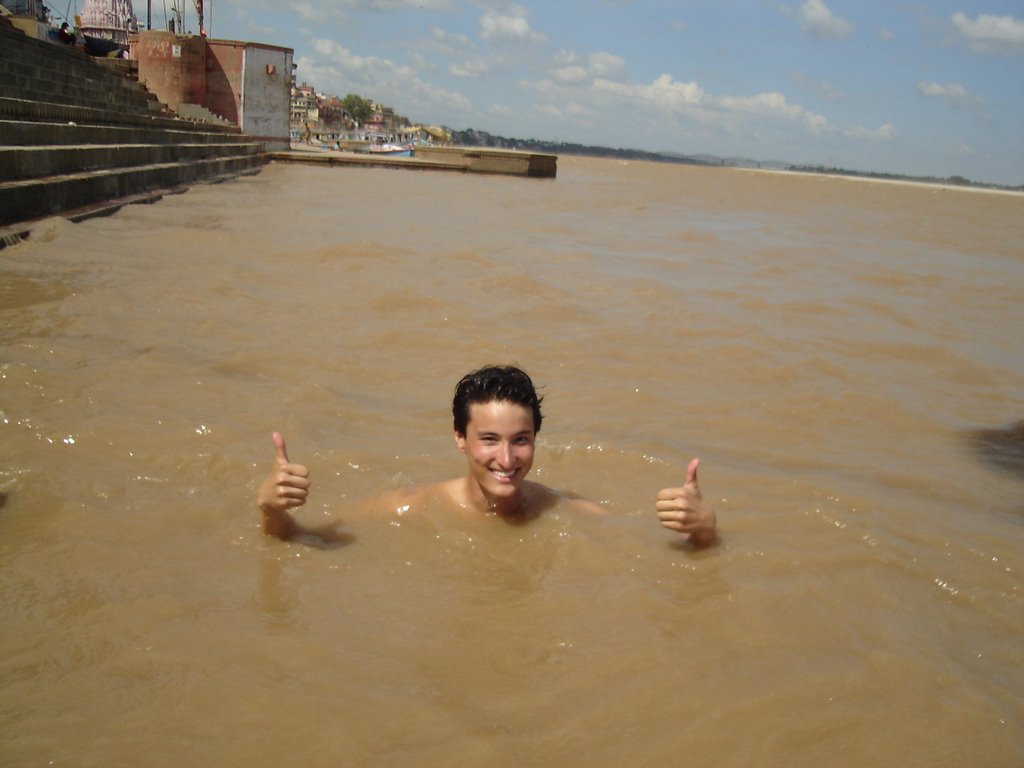
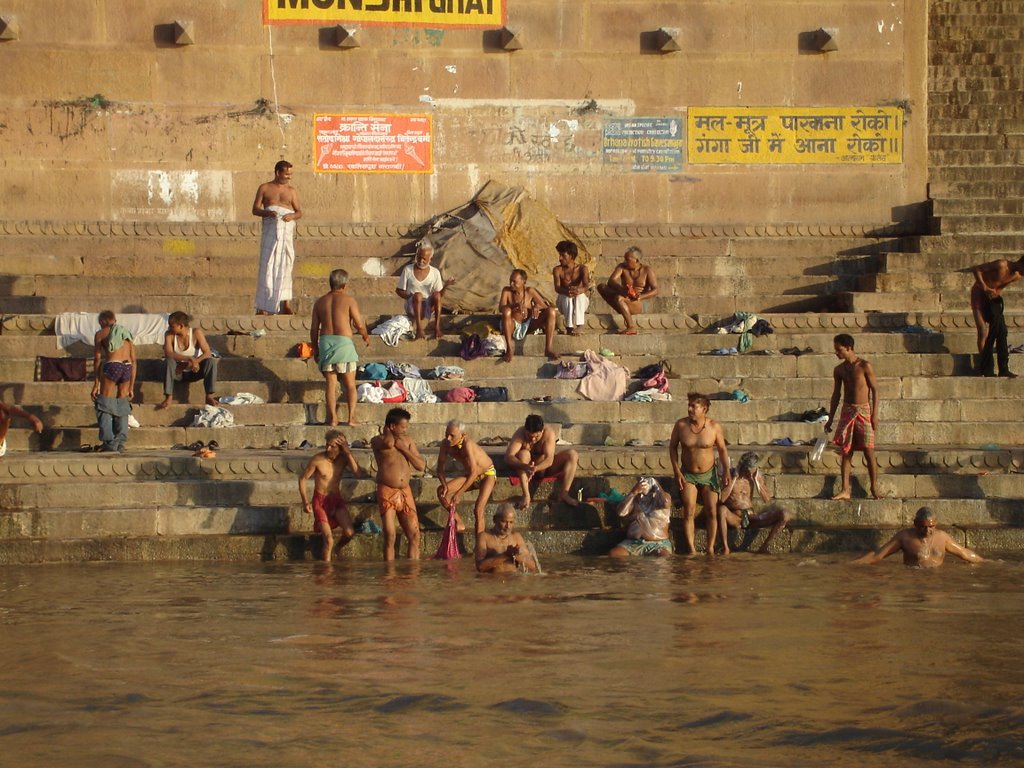
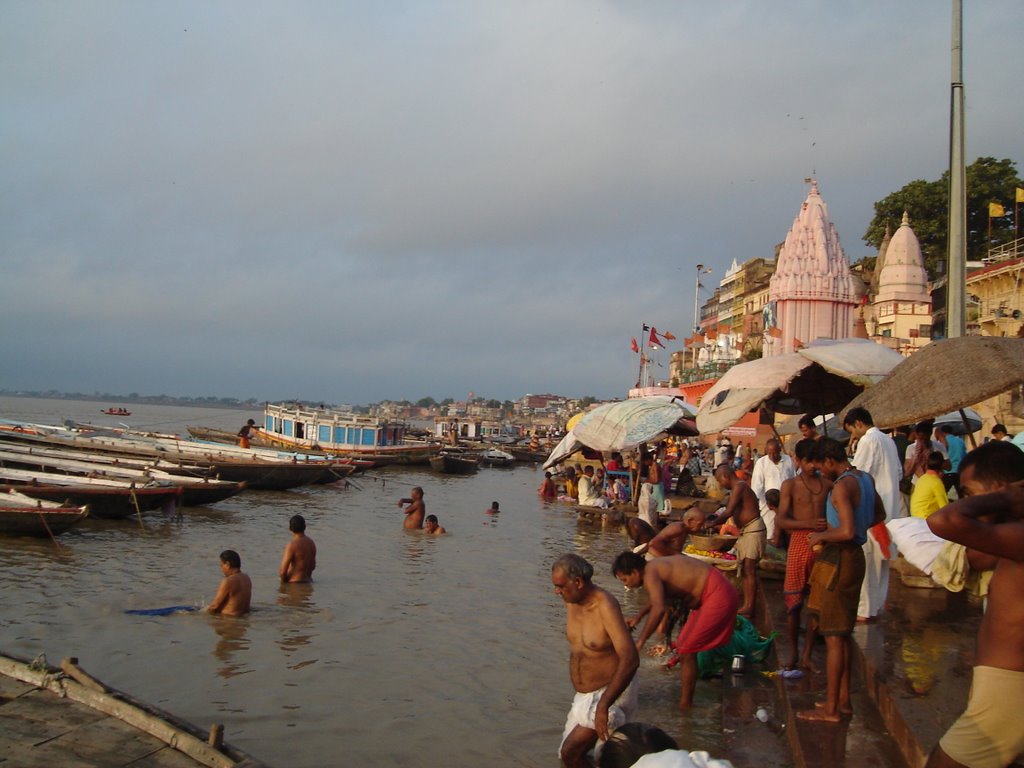
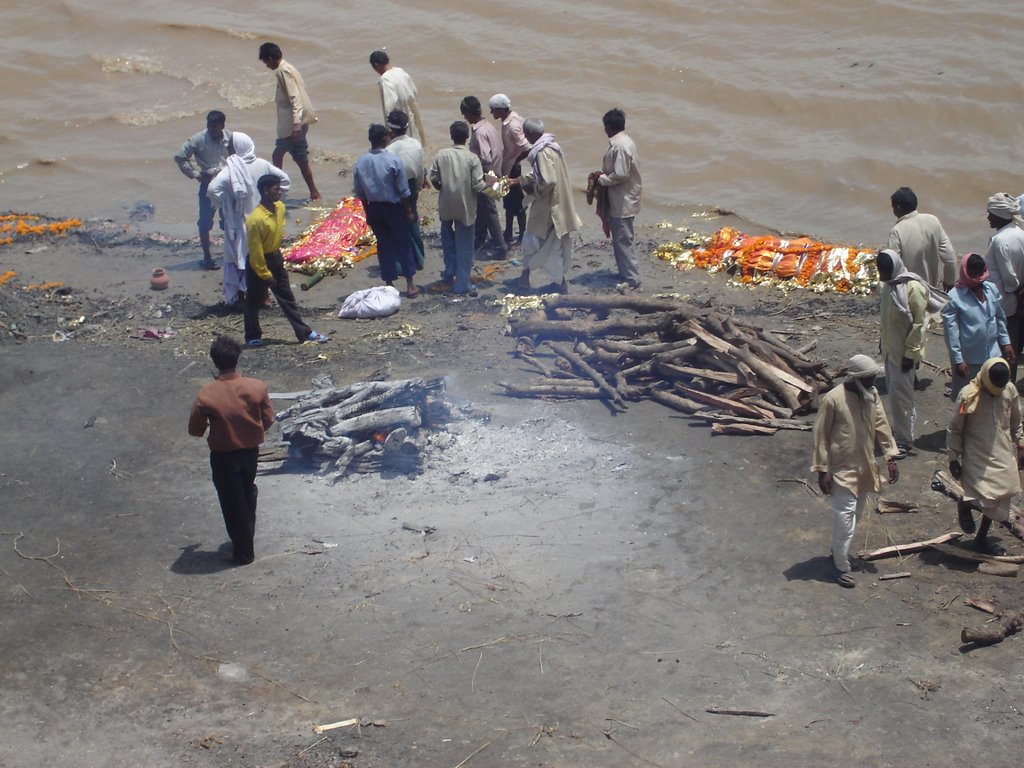
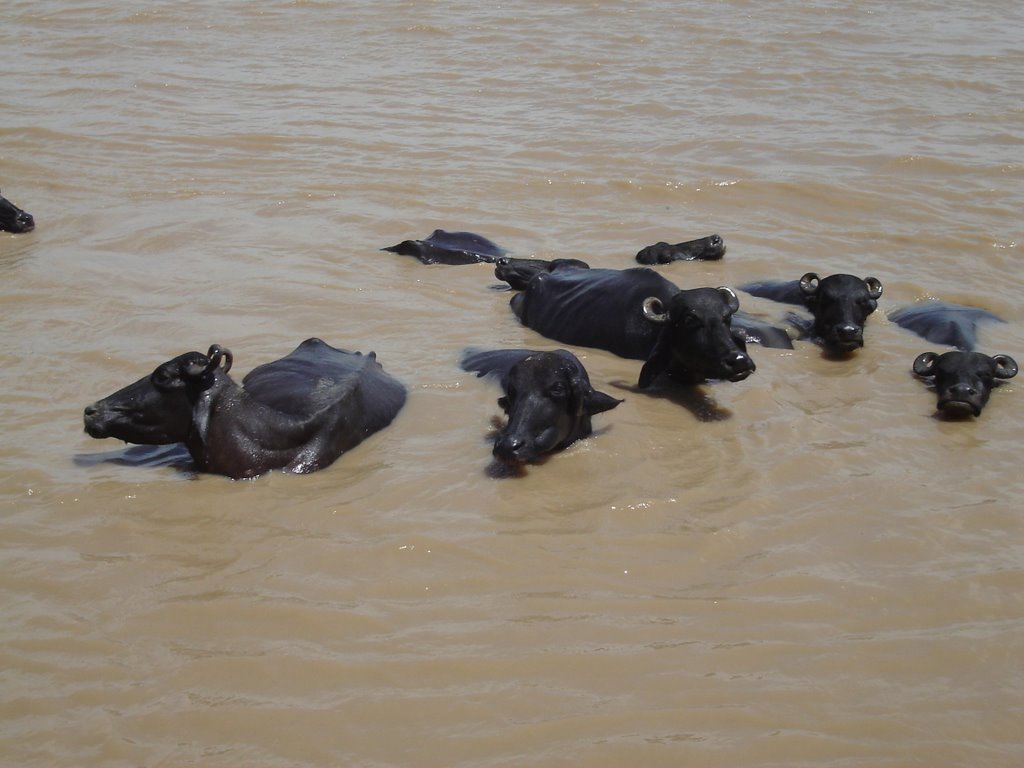
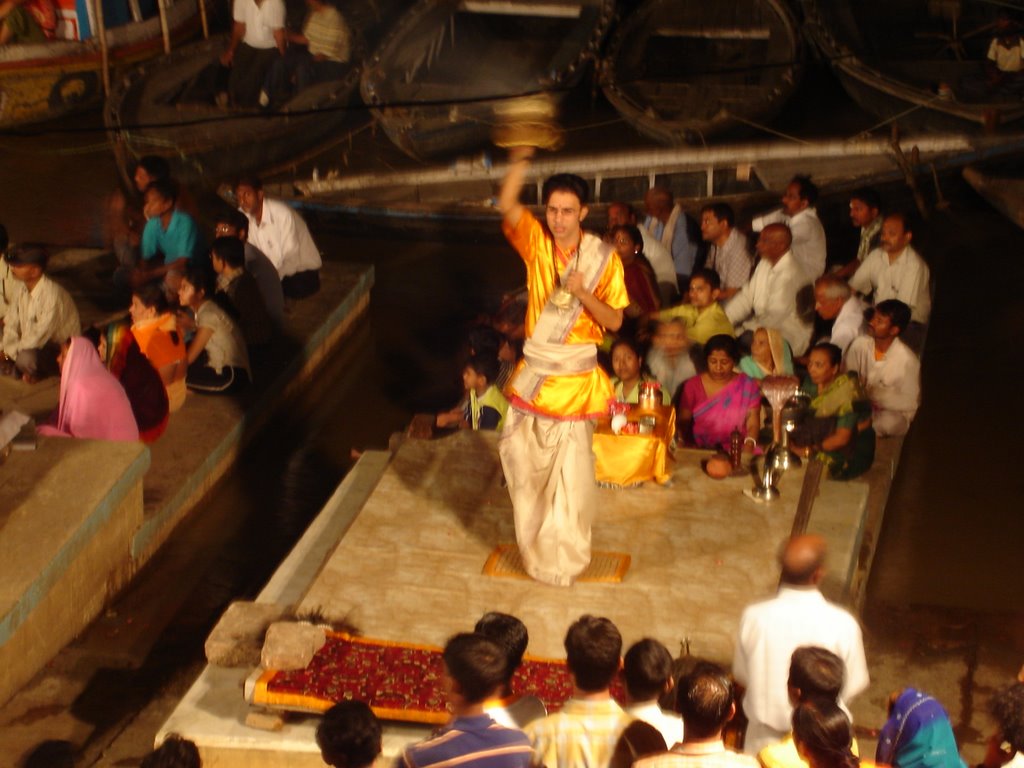
I woke up at 5 am (it’s like I’m on a ski vacation) and walked down to the ghats (banks with stairs into the Ganges). The nearest one is Harishchandra (one of two cremation ghats). I haggled with the boatmen to pay only 200 Rs for two hours, down from 750. One of the boys rowed the boat down past Hanuman ghat (steep stairs leading down to the river) to Chet Singh Ghat, a red sandstone fort built by a rich Hindu king. There were a bunch of boats toting tourists around at sunrise, when the majority of bathers are out. It’s like a boat safari, everyone trying to spot animals at the waterhole. I bought a prasad of flowers and candle to offer the Ganga. The water was a milky brown and cloudy; it’s impossible to see even an inch down. Maybe this is because: The water is so polluted that it is septic (meaning no oxygen exists), 60,000 people bathe here a day, 30 city sewers discharge here, the city is only 7 km long, and it has 3000 times as much faecal coliform bacteria than bathwater. Nevertheless, I could see splashes of water from fish. The Ganges was pretty fast-moving, exemplified by the fact that the boatman didn’t even have to row. We floated north past the intricate Bengali Hindu statues above colorful Kedar Ghat, a popular spot with South Indians and Bengalis. Moving along, after some modern guest houses and homes, we came face-to-face with the imposing red wall of Mansarowar Ghat, built by a Rajput king, named after a Tibetan lake, home of Shiva. The walls probably ascend 50 feet, in case of Gangetic flooding. Adjacent was Someswar Ghat, where men were diving off a high ledge and floating down to the main bathing ghat. Sometimes it seems more like a pool than a bathtub. Munshi Ghat is next, with large stairs. Ahalya Bai Ghat has a Shiva temple, therefore many Hindus bathe here. Rana and Dasaswamedh Ghats form the main bathing ghat. They exemplify quintessential Varanasi. Men, women, children, elderly, and sadhus all come to bathe in Varanasi, the most holy of spots in Hinduism. The whole range could be observed from here. Men shed their collared shirts and cloth dresses, down to prayer necklaces, briefs, and loincloths, and step down into the muddy water, where they clasp their hands in prayer, drink from the river, and scrub their bodies and hair with soap. Women submerse while fully clothed in saris; wash their hair, carry children into the water, wash their families’ clothes, and fill golden brassware vials with the holy water. Young men pilgrims, in conspicuous orange shorts and shirts, all play in the water, as do naked children. Sadhus, dressed in nothing to chalk to saffron robes, dip in the water, hoping to be purified. The dhobis bring their washing here, taking each piece of clothing out, rinsing it in the murky water, and slapping it against the stone steps, before setting it out to dry on the steep embankment. The full and complete range of Hindus can be seen here. The last stop on the circuit was Manikarnika Ghat, the main cremation ghat and the most auspicious spot for a Hindu to be cremated. After my time was up, the boatman rowed hard against the current back to Harishchandra Ghat. I went out and got some breakfast at a hotel, and then I walked through the Old City. It is filled with stone buildings, religious shops, restaurants, internet cafes, souvenir shops, music and yoga parlors, and guest houses. Hindu temples continue to pop up everywhere, in random alleys, next to hotels, and cut out of banyan trees. A lot of English, Spanish, Italian, French, Japanese, and Korean tourists were out and about, so naturally beggars and touts flock here like vultures to pray on them. Hindu pilgrims come in large numbers for purification and funerals. Cows and dogs were also abundant in the narrow winding dirt streets, and with them come mine fields of shit everywhere. I had heard Varanasi is famous for Benares silk, especially for saris. So I went into a large silk store and picked out five beautiful saris for presents, and I ended up paying 500 Rs each, which seemed fair. They neglected to tell me, however, you need an under-piece, so I had to pay another 500 Rs for those. I wanted to see a burning ghat, so I went down to Harishchandra Ghat. I was taken by a “volunteer” guide to a watch tower high above. Pictures are not allowed out of respect (but being me, I obviously couldn’t resist), so I had to hide my camera in the crook of my arm while snapping photos of the ceremony. Is that really bad karma? I felt like I was a covert photographer in North Korea. The guide explained to me that he is a dom, meaning undertaker caste. He and his family cremate Hindus and non-Hindus (the other cremation ghat, Manikarnika, only allows Hindus) wanting to reap the benefits of being cremated at Varanasi, which gives the soul instant liberation. This is an untouchable caste, but they are needed and hold a unique place in society. I was informed that in a normal funeral this is what happens: The person dies (obviously). The relatives are called and congregate as soon as possible afterwards. Only men are allowed to attend the ceremony because it is thought women get too emotional and cry (this will disturb the spirit and turn it to a ghost) and because there used to be the fear of sati (a good widow performing self-immolation). The wood is set up so that the body will burn efficiently. The mortuary stockpiles cremation woods shipped from Madhya Pradesh, different varieties costing different amounts. It takes 360 kg of wood and three hours to burn a body. Sandalwood, the most expensive, is 3000 Rs per kilo. The corpse is dressed in shiny gold sheets and carried through the Old City on a bamboo stretcher by doms. Then the body is bathed in the Ganges and placed in the wood structure. The eldest son (or other close male relative) then conducts the ceremony with a cleanly shaven head and wearing a simple white cloth. This is one reason why parents want sons instead of daughters in India. He gets reeds and lights them with a flame, still ablaze at the cremation grounds since the time of Shiva. He takes these reeds and circumambulates the body five times (because the body is made up of five elements; fire, wind, water, earth, and plasma) before igniting the cremation fire. He then pours food and sandalwood powder on the body, to offer it a last meal and a nice smell. There the male relatives and friends wait three hours for the body to incinerate. After this, the ashes are collected and thrown over the shoulder into the Ganges without looking back at them because this could turn it to a ghost. This is trivialized by the fact that poor people stand near the cremation grounds with baskets sifting through the wet ashes in hopes of finding a gold tooth or ring. After this funeral, for seven days the son goes into solitude and then there is a ceremony with the rest of the family. The only people who are not cremated are those who are already pure; pregnant women, children, lepers, snakebite victims, smallpox victims, and sadhus. Instead, their corpse is put in a bag with stones and thrown, as is, into the middle of the river. How sanitary. Watching the ceremony was enriching; it gave me an insight into Hinduism that I hadn’t seen before. It seems very superstitious, based on purity/pollution, and hierarchical. It was also rather shocking and gross. I was right in the line of smoke, so my eyes burned the whole time. That’s the first time I’ve seen a dead body. They put them on the pyre and they charred the bodies. There was a clear outline of the blackened corpse engulfed in flames. While burning, I could see the creamy intestines and other organs spilling out. Sometimes the dom would have to adjust the fire to burn more efficiently, and this would mean poking at the body with a bamboo stick. There were even cases where a leg or arm would come unattached from the rest of the body, and they’d have to throw it back in the fire. After watching for a while, I walked along the riverfront (away from the cremation ghats) to Munshi Ghat, near the main bathing ghat. I passed on the way a herd of black water buffalo in the water cooling off. I got jealous, considering the sun was baking hot and it was over 100 degrees outside. So, even though I vowed not to go in the Ganges at Varanasi, I dove into the water, dunking an auspicious five times. I tried as hard as I could to keep every orifice in my body closed. At least the water was fast-flowing and it’s monsoon so there’s more water compared to toxins. Okay, just humor me, smile, and say ‘You’re right’. I give it until Wednesday before I get jiardia and/or cholera. I collected Ganges water in my water bottle to bring back home. Immediately afterward, I looked for the nearest temple (there’s one like every 5 feet in this town) and prayed to Shiva, god of destruction, to destroy all harmful disease and parasites I may have ingested in the Ganges. I went back to the hotel and took a nice shower (‘nice’ because I didn’t bring soap or a towel). I ended up drip-drying off in ten minutes because it’s so hot. I walked to Dasaswamedh Ghat, which was filling up with Indians and tourists for the Ganga Aarti ceremony at night, paying respect to Mother Earth and her lifeline, Ganga, the goddess of the river. Touts were out in full force today. First, an able-bodied beggar man came up to me and acted offended that I was ignoring him. I thought it was acceptable not to give him money, until I saw that all the Indians had given him money. Next, an old man came up to me and shook my hand. He started massaging my hand and arm and said an Ayurvedic massage only cost 10 Rs. So I got an awesome full-body massage from him. Then the guy charged me 150, saying that 10 was only for the head and neck. I was steaming furious (and it’s hard to make me mad). I paid him because a crowd on Indians had gathered. I lost it and threw the money at his face and stormed off, cursing. Next, these guys seemed genuinely interested in meeting me, so I talked to them. All this guy said was “My girlfriend’s booty big, but I am small. I like.” What?!? Then his friend kept touching my arm and they invited me to chai. Wow, awkward. Then a postcard seller kid was hassling me, and some random guy demanded money for sitting with me while I was getting my massage. After this, I retreated onto a balcony filled with only tourists. Aaahh! Finally, I can see what people are talking about when they say everyone is trying to rip you off and the touts are overwhelmingly annoying. I can’t even imagine what it would be like as a, say, young blonde girl in India. There was a sadhu in the crowd that was the live Indian version of Jack Sparrow from Pirates of the Caribbean. The Ganga Aarti ceremony was boring. Five Brahmins dressed in gold waved bells, horsehair brushes, and torches to the beat of bells and drums and sacred chanting music. Then the crowd chimed in, chanting “Ganga Maa”, and clapping. The priests then handed out rice as gifts. I walked out of there past all the street vendors. It was like getting out of a baseball game; a massive flow of humanity in the streets. There were tons of uniformed police officers with assault rifles. Too bad they don’t do anything except sit in the station and socialize. I went to a nice AC restaurant and got a thali as usual. I came back to the room and after about an hour into my sleep the power went out. I wouldn’t normally care, except for the fact that there are no bug screens or AC, so the fan didn’t work and I couldn’t even open the window for some airflow. It was unbearably hot, I was drenched in a pool of my own sweat, and I couldn’t sleep for at least two hours.
Saturday, August 12 Bus and Train from Khajuraho to Varanasi


I had to wake up at 4 am (I more frequently go to bed at that time than wake up) to catch the bus in time for my 11:30 train ride to Varanasi. I walked in the pitch black night to the bus station (I was petrified, I don’t know of which more; creatures or people). I ended up waiting for 30 minutes at a tiny town Bamitha. Mosquitoes were so annoying that I couldn’t even sit still without attracting them. The bus to Satna was nice because the morning sun was rising against the yellow-green of rice fields and cow pastures. Except that I had to vacate my window seat for a lady who was vomiting out the window. I got to Satna, a dull transit town, at 9, so I bought my meal for the day (two bananas) and went to a nearby temple before dying of heat sitting in the room for AC passengers (called the "Upper Class" Waiting Room). I was in the middle of rural India; women carried firewood on their heads into the train, signs were exclusively in Hindi, saris only (no salwar kameez or pants). Remember how I woke up at 4? Turns out my train was two hours late (I had a fun-filled day spent sitting in the Satna Railway Station). I finished the book Siddhartha (in preparation for Bodhgaya), but the whole time I thought the character Siddhartha was going to become the Buddha, but really he’s just a random Indian guy! The whole day I had two bananas for food. I slept on the train to Varanasi, which passed through the busy holy city of Allahabad (sounds pretty holy to me, as “Allahabad” in Urdu means "God City”). From what I saw, it was all a bad city (pun intended…sorry). Kids were flying Independence Day kites on rooftops. The tracks lay on litter-covered dirt with holes, from which hundreds of rats scurried to and fro. It was one of the scariest and most hideous things I have ever seen. But I couldn’t stop watching from the safe haven of the train. I got into Varanasi, the holiest city in Hinduism (kind of like the Hindu version of Jerusalem to Christians…and Jews…and Muslims) and one of the oldest living cities on earth (2000+ years). Its name derives from its location; at the confluence of Varuna, Ganga, and Assi Rivers. Hundreds of people were sleeping on the floor everywhere, and my cheap ass was tempted to, but I decided that I could afford the $3 to not sleep on the dirty floor among flea-ridden dogs, rats, mosquitoes, lepers, and thieves. I was instantly bombarded with touts, trying to take me to a hotel which would pay them commission. I told him I wanted a cheap hotel, and he proceeded to take me to the YMCA ($15 a night for non-AC). Instead, I ended up a block away from the Ganges in Safari Lodge. My room was not luxurious, but had a good shower and bathroom, and fan. I slept dressed in all my clothes because there was no bedding.
Friday, August 11 Bus Ride to Khajuraho, Temples
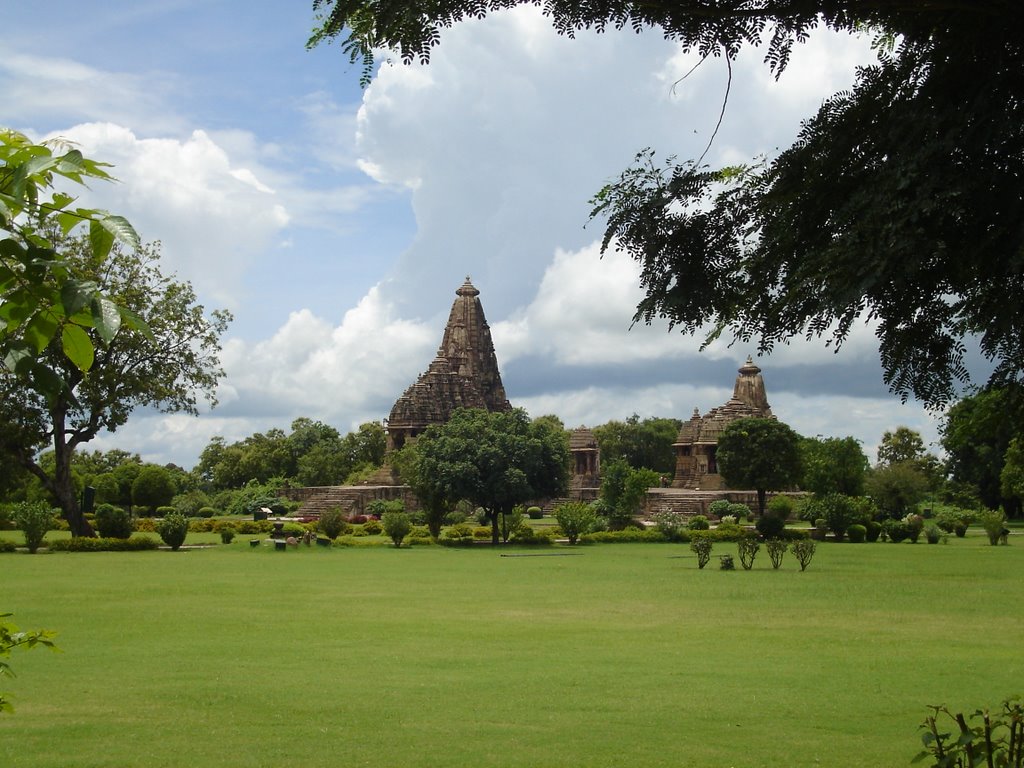
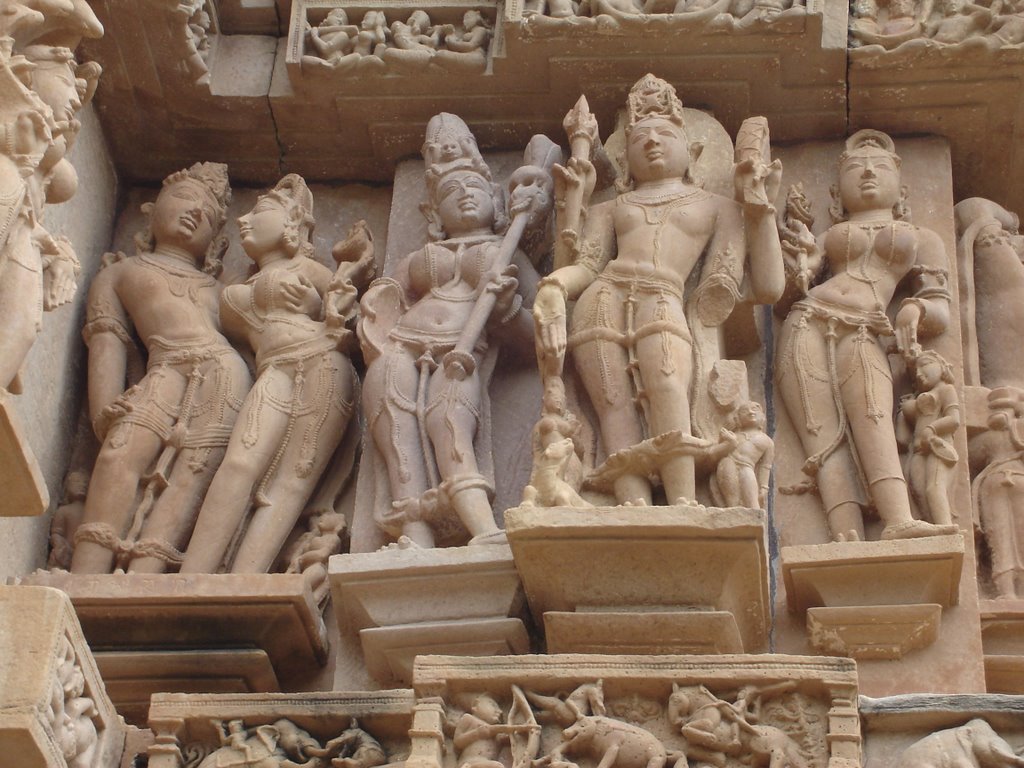
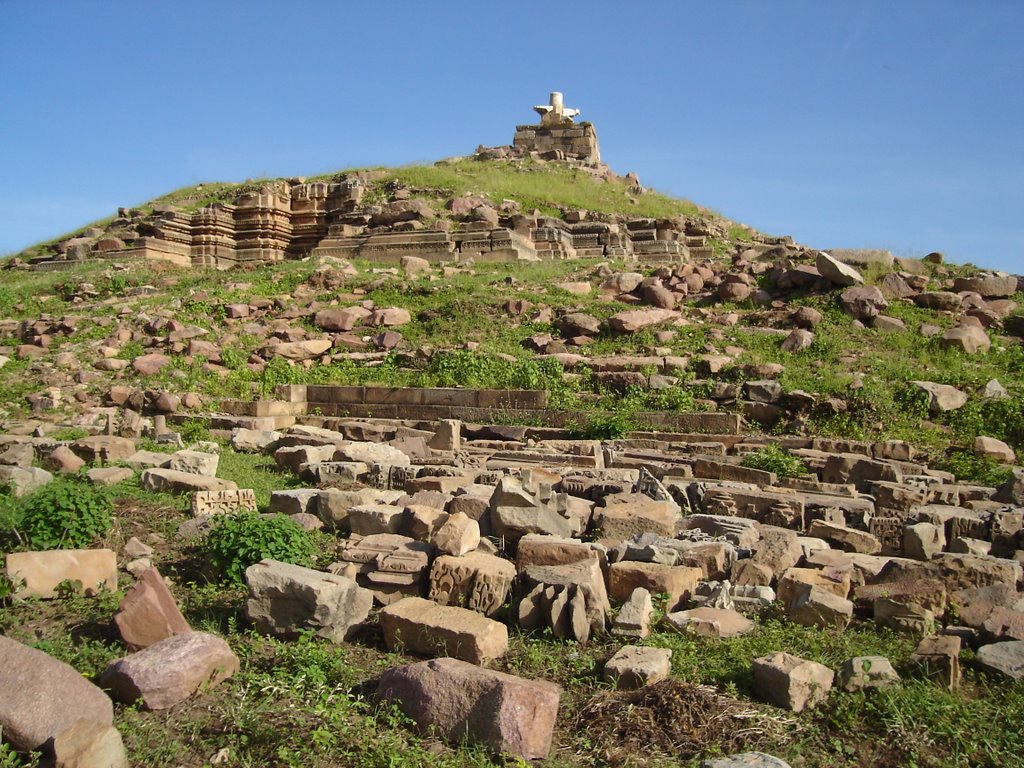
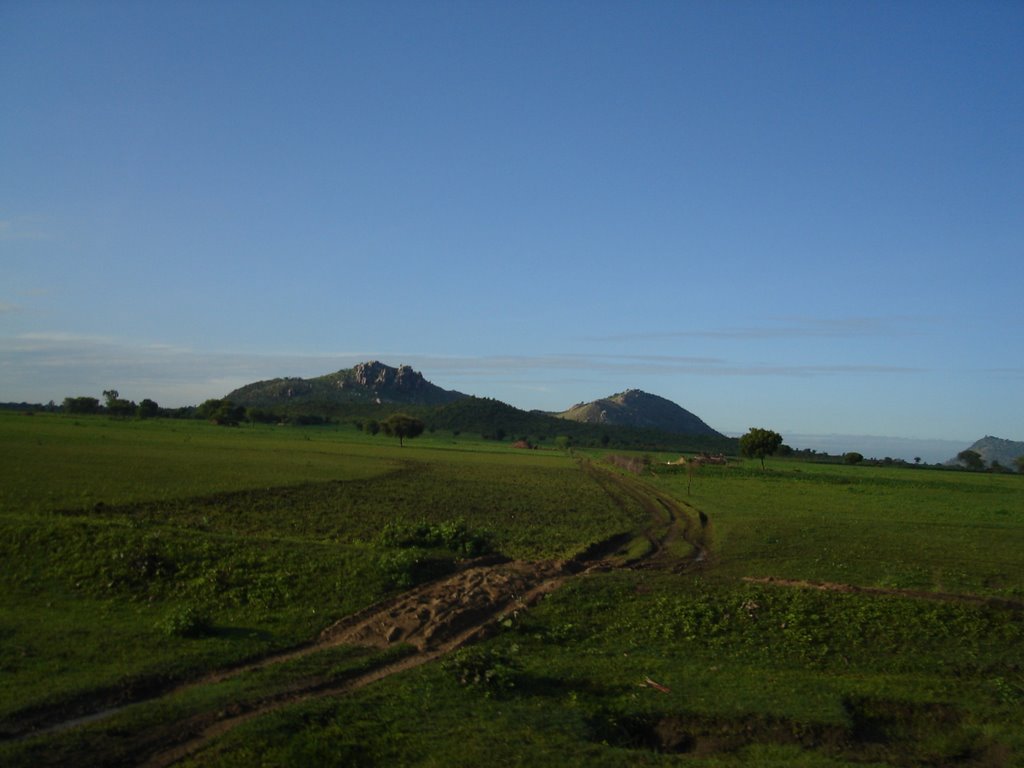
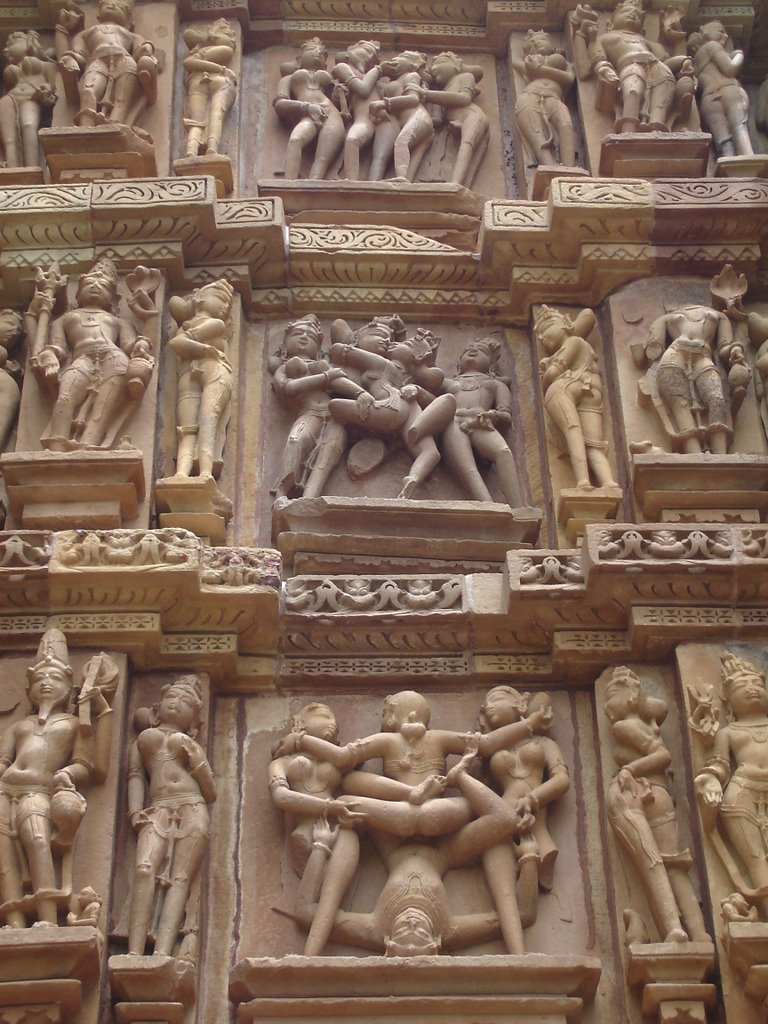
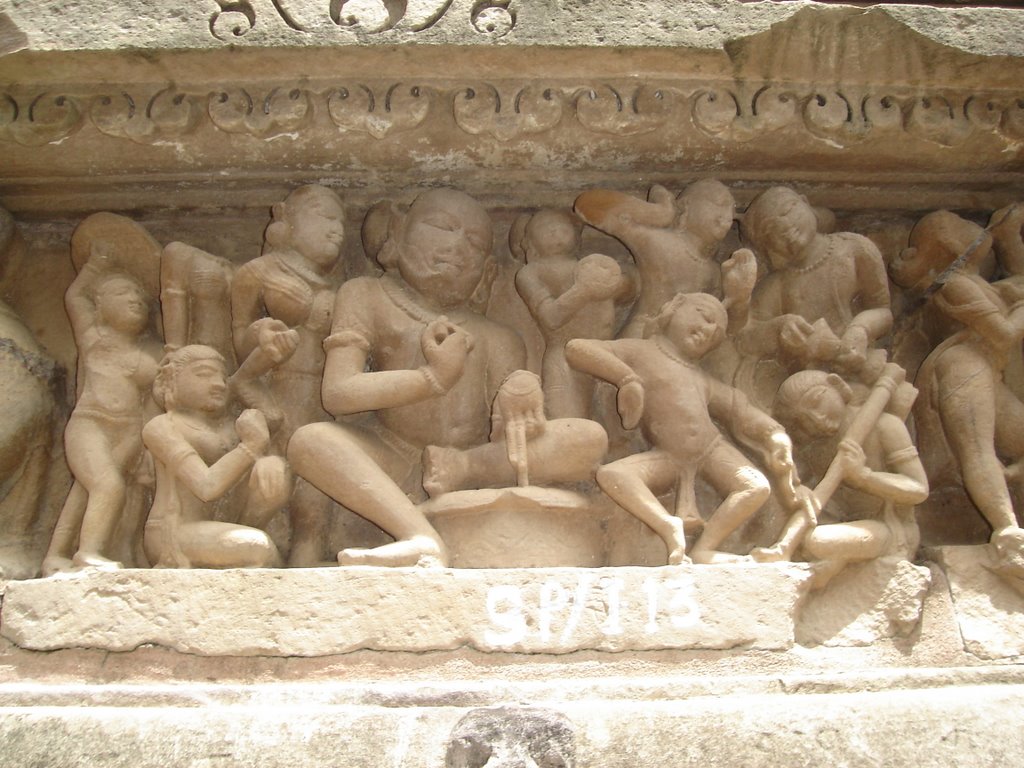
I was awoken on the train to Jhansi by the conductor, at 4 am. I had to stay at the train station for an hour before the bus for Khajuraho came. It was dark and bugs were everywhere. The bus came right to the train station, and I was one of three tourists. It was an awesome ride, the sun rising over the green agricultural and forested plains of Madhya Pradesh. It was flat, save for rocky hills that sprung out of the greenery. The trees included mango, eucalyptus, and palm trees. The whole way was rural, but people were not absent. Large open fields were filled with squatting people old and young, enjoying their morning defecation. This occurs because there is no running water for toilets, and because it is thought that if the sun isn’t out yet, no one can see you. Except for the fact that entire village is out there with you doing the same thing. It’s actually seen as a social event in India, so friends will often go out together. One question; How they wipe, if at all? After a short stop in which I saw a rural village woman carrying an emaciated baby with flies covering it, we were on our way. We had to stop for a plethora of white cows, which were numerous. I met a man from Khajuraho on the bus, and we talked about hotels and the holiday on Wednesday. As we neared Khajuraho, you could see the small airport and the five-star resort hotels. Getting off the bus at 9 am, I was hoarded by noisy pushy rickshaw drivers. I told a bicycle rickshaw driver to take me to Lakeside Inn, where I checked in and stayed for 100 Rs. Even if he ripped me off and got a commission, that’s still one night’s stay for $2. I took out some money from the ATM because it cost 250 Rs for foreigners (compared to 20 Rs for Indians) for admission to the World Heritage Western group of temples. The temples were breathtaking. The complex would have been destroyed following the Mughal onslaught, but instead is well-preserved because of Khajuraho’s isolated location. Originally built by the Chandela dynasty in the 10th century, they are an insight into the life of everyday Chandelas. But how they built them in such a short time, and what some of the figures represent remains a mystery. Walking clockwise, I first came to the Lakshmi and Varaha, two small shrines facing the larger temples. The first large temple is Laksmana temple, dedicated to Vishnu. Inscribed in the temples at eye level, there are intricate carvings depicting the life of Chandelas. Statues include people playing music, celebrating, riding elephants, hunting, fighting wars, killing demons, and screwing horses. Further up are larger statues of royalty and deities. Big-breasted dancing women with jutting hips are shown wearing jewelry and loose shawls. Men are shown carrying weapons and wearing ornate regal crowns. Kneeling servants are 1/8 of their size. Gods like Ganesh, Shiva, and Brahma are always above the viewer, ascending into the sky. Erotic Kama sutra figures don the walls, and continue to baffle experts. Some say that it was an instruction manual for inexperienced Brahmin boys, others say it is because the gods liked them, but I think it’s because every aspect of life is represented on the temple façade and sex is part of the celebration of life. The temples all have stairs leading to a covered altar to the particular deity. All have a tall spire towards the back, largely void of intricate carvings. The Kandariya-Mahadev temples are larger and dedicated to Shiva. Then, walking forward is the Vishvanath, guarded by ornate elephant sculptures. What’s interesting about this park is how accessible the statues are; you can literally reach out and touch these priceless 1000-year-old sandstone carvings. It started to rain, but I didn’t care because it was 100 degrees. I was just soaked with sweat AND rain. After visiting these temples, I was harassed by endless amounts of touts, and one such man talked me into buying five Kama sutra books, a guidebook, and postcards. Then another hawker lured me into his shop and somehow convinced me to buy tailored Krishna shirts (needless to say, utterly worthless). A lot of the touts make it seem like they’re your genuine friend, which I find disgusting. By the end I was tired of hearing the phrases: “You look my shop”, “You look like Indian”, “Oh, you are student? I am also student”, and “I love America”. I had to even lie and say I would meet people, when really I stood them all up. I rented a bicycle and rode with this one German traveler, Christian, one of those weird Euro hippy people with long hair, Capri pants, and hemp shirt. We visited the next set of temples, the Eastern group (actually Jain temples). All the deities were naked because that way they’re not killing anything (yes, it’s weird…their savior is a middle-aged fat hairy naked man). The rest of the temples were the same, with Chandela figures doing everyday things, with kings and nymphs, and deities. I gave up reading the informational signs, which were incomprehensible to me (an educated native English speaker, let alone an Indian). In order to get to the other smaller Jain temples, we had to ride through the ancient village, with dirt roads, water buffalo, women carrying water on their heads, men playing cards, and children playing in the street. These temples were not impressive compared to the others, having few sculptures. The southernmost temple (which was actually a Shiva linga atop ruins) was cool because it was under ground. Pieces of intricate statues carelessly lay strewn about around the site. No pictures were allowed (but they obviously hadn't heard of Tyler Rapp). I came back and had some dinner. On the way this kid named Golu invited himself and I felt bad so I ordered him a dinner. But I hated him; he was 11 and was a brat and kept insulting me (and lied that he didn’t want anything from me, even though he wanted me to go visit his brother’s shop). He took me to the Shiva temple because there was a nightly puja ceremony that has been happening for centuries there. The room was filled with a huge 10-foot tall Shiva linga. Priests struck loud bells while chanting. The devotee is expected to pray, touch the linga, apply a bindi, and touch the fire, while walking in a counter-clockwise fashion. Basically, everyone was praying to a 10-foot tall phallic symbol. After that I had to get rid of Golu, so I said I was going to bed now (it was about 8 pm) and he insulted me for that. He couldn’t follow me on the street or else the police would beat him for harassing tourists (is it wrong I wanted to go and stand by the police?). Then this other kid (while he was urinating) turned and asked me my country and told me to come over to where he was peeing so I could meet him. I think I'm fine, really, thanks though.
Thursday, August 10, 2006

Thursday, August 10 Class that never ends

The first class was held in Veena Kukreja’s office, and it was only the California students. She had note cards about the emergence of Pakistan, which she recited word-for-word. It was extremely boring, but what made it amusing was how much she was bashing on Pakistan. I get the impression she doesn’t have any clue what’s going on with scheduling and doesn’t really care. She’s so clueless she’s going to call us as to when class will be held. Then, the second class “India and the World” has about 70 students, and the teacher Shanta Verma is really strict; she didn’t let four students sit in class because they were late, she belittled anyone who asked questions, and she told us that if we spelled an acronym wrong, she won’t hesitate to reward us with a 0 for the entire paper. She’s a good lecturer, but it was extremely uncomfortable in that room. The chairs were hard, I had no food or water, and it was stifling. I almost fell asleep, but was kept awake by the mere thought of being caught. Apparently, Snehal's sister called her to find out what time class was at, and she called her to the front of the class and chastised her publicly. Class lasted an eternity; I don’t know if I can handle it anymore. I came back and had lunch at Fiesta.

Wednesday, August 9 Rakhshabandan Holiday, Becoming Indian, Travel Agent

Today is the Hindu holiday Rakhshabandan, because it’s the full moon. The girls tie bands around their brothers’ wrists, and the brothers reciprocate by giving gifts to them. On the Metro I saw lots of men with red bindi on their foreheads and with colorful flower and string wristbands. I give up, and now I open my bag so the armed uniformed Punjabi security guards can look in it, and then I put my arms up as if to say “Please frisk me”. Not like it does anything but deters people. If you wanted to smuggle a bomb, all you’d have to do is put it in your laptop case and say it is a computer, like Ro did (except his actually was a computer, not a bomb). After all, the reader board also says: “Report all suspicious object or bag. It could be bomb”. I love the language barrier. Speaking of the language barrier, I am slowly but surely becoming Indian. Whenever I talk to Indians, I do the side-to-side head nod and change my speech patterns. For example, I say things like “Is okay put here?, Please you tell, what does it mean ‘panni’, Your grade in this paper [meaning ‘class’] is worth 100 marks, I am having 200 Rupees”. I am incorporating a lot of British vocabulary used by Indians like ‘conductor, platform, mind the gap, mineral water, kindly’. Whenever I talk to Indians in English, I use an Indian accent. I’ll probably be really good by December. You just put your tongue more on roof of your mouth, and sound more British. Surprisingly, it’s a lot easier for them to understand, as condescending as you feel actually doing it. Sarah York called me, which was nice. She apparently only has one picture on her otherwise bare wall; of me in acid-wash jeans. Great. I went to Connaught Place and there I saw the travel agent. They charge 150 Rs for commission charge, which is worth it to avoid the hassle of waiting in endless lines at the train station. However, they initially tried to charge me an extra $20 on the train ride from Varanasi to Delhi. I looked it up and they had conveniently put the train number (2301) down as the price (actually 1150). I thought he was trying to cheat me, but it turns out it would have printed that price on the ticket anyways. So I have finally found a reputable travel agent! I came back and unfortunately ate Fiesta again. They love teasing us. On their menus they have pictures of a mouthwatering steak (for some reason with a Mexican flag toothpick in it), juicy hamburger, banana split, piñata, and fries with grilled cheese sandwich. None of these foods are served at Fiesta. I was looking at college bookstores in Kamla Nagar for the required texts for class. None of them had any one of the books we need. Guess what that means? Tyler is not going to read all semester. Oops. Hindi was unbearable again. Hindi is different in that there is no word for “thank you”, “sorry”, “excuse me”, or “have”, and there are over a hundred words for “love”. I don’t learn anything in Hindi class. Rahul came in and got mad when he saw the tickets on my desk and realized I hadn’t invited him with me on my trip. Then he proceeded to call me low-class because I was wearing acid-wash jeans. Yes, because I wear acid-wash jeans ALL THE TIME at home. I think Westernized Indians are very flashy and materialistic, no more than Americans, but there is no stigma with flaunting wealth here, and it is socially acceptable. It would be like me saying “Hi, I’m extremely wealthy [which I’m not by the way] and I hope you all know it”. But in India that is how one asserts social status and prestige. We had a tiffin service come and cater for dinner; puri, rice, tikka masala, and aloo. We’re going to do this instead of getting a cook, which seems like a good alternative because we'll be out a lot. We watched Rush Hour and I went to bed. I couldn’t fall asleep because I was being eaten alive by a horde of malarial mosquitoes.

Wednesday, August 09, 2006

Tuesday, August 8 Class, travel plans, desperate landlord

I thought I had class, but all we had to do was meet with the teacher, Veena Kukreja, for thirty minutes. Basically, she told us that on Tuesdays from 9-12 she will be teaching State and Society in South Asia. Then, on Thursday from 9-11, she will be teaching State and Society in Pakistan. That means that if I took the Pakistan class I’d only have class at DU for four hours, one day a week. But I’d have to take a class on Pakistan instead of India, which is a waste of my time. And that still leaves the problem of Hindi on Monday and Wednesday. So I’d have class Monday, Wednesday, and Thursday. There is just no way to win at this scheduling. They want us to be as unaccommodating as possible. No fun allowed. I came back and learned that everyone is planning on going to Kerala for the week-long break this and next week. Since I’m going already in December after the program, it's therefore a waste of money. So I’m planning on going to Varanasi (the holiest Hindu city, on the Ganges, where Hindus come to die) in Uttar Pradesh, Khajuraho (which has World Heritage temples famous for erotic sculptures) in Madhya Pradesh, and Bodh Gaya (most important Buddhist pilgrimage site) in Bihar. I figured I am in India and I want to see as much as possible while I’m here. I will most likely travel to Southeast Asia and the Middle East on another occasion. I went to Connaught Place with everyone and we had Subway for dinner. I got two delicious sandwiches. It’s expensive, and the serving area is split into Veg and Non-Veg, much like Kosher. We went back home and Rahul Jain’s parents had just arrived from the US, so he had his iPod that he wanted to show us. And he ended up staying in my room, talking on my bed for THREE HOURS while I wanted him to leave so I could sleep. Moreover, he was asking us guys inappropriate questions. He seemed really interested in America, asking, “Is prostitution legal in the US?”, as he explained about prostitution here. He has “volunteered” to escort the girls to Kerala (what a service he’s doing them). And when I told him I wasn’t going with them and I was making my plans tomorrow, he proclaimed, “I will go with you. Make your plans for two people.” Let’s see…NO! Congratulations Rahul, you have crossed the line from weird and pathetic to creepy and desperate. I was awoken three times that night because the girls went to a gay club (I didn’t even know they had those in India) and Mariel went missing for like two hours, and they got locked out of the house.

Tuesday, August 08, 2006

Monday, August 7 AC issues, first day of Hindi class, travel deals

I woke up when we neared Delhi on the train. I got all my belongings together. The sun had barely risen when Alix and I emerged from the train and walked like cattle through a sea of humanity outside. Alix was violently yelling at rickshaw drivers and then found out the Metro was closed for 30 minutes. For some reason she refused to wait and I was too scared at this point to argue, so I had to pay for a rickshaw I didn’t want to take. Mildly awkward ride I'd say. I spent a couple hours with photos and journaling on the terrace while the others slept in. Pigeons, hawks, and even a female peacock all flew overhead as the sun was rising. Later it got extremely hot. I unpacked all my things, and took a much needed shower. I wore my t-shirt that says “One Nation Faith Tested Since 1776; The Nation That Prays Together Stays Together”. So extreme that it’s hilarious. I ate lunch at…guess where? Fiesta! And sat at the same table and ordered the same thali. I now just drink their tap water, because in any good restaurant it’ll be safe with Aquaguard. Today the beds came for the girls’ rooms, and so did all the kitchen wares. The AC repair man came to move the AC from the common rooms to the bedrooms. That sucks because I feel that the common rooms will never be used anymore because they’ll get too hot. So basically everyone is going to be locked up in their own rooms and anti-social for the rest of the hot season. I had to help carry the AC unit upstairs. It was all wet and dirty, and there was a wasp nest, too. So currently, there’s a hole in the window in the living room with a horde of wasps flying in and out as they please. So the workers remedied this by taking a stick, putting some kerosene on the end, and lighting them on fire. Now it smells like smoke and it’s an open-door immigration policy for mosquitoes or other bugs. My cell phone tells you your location (much more advanced than in the United States). At home it says “Old Secretariat”, because this area (Civil Lines) was where the British officials set up temporary camps while the capital city, New Delhi, was being built. In the afternoon I had to attend the first class of Hindi. Apparently for Hindi, attendance and giving the teacher ultimate respect is very important. The respect issue is to be expected; the attendance just plain sucks. I really don’t want to have class four days a week. I’m really not coming on Mondays. Moreover, besides the unfortunate scheduling, we probably have the worst group of students that the UC system has to offer. Jocelyn asked how to say “I’m lost”. Do you really use that? How about let’s learn how to say “I’m a lost and vulnerable American tourist. Please rob me and rape me.” She single-handedly made the class go an extra 30 mintues. In addition, Katie (quintessential American prissy ignorant tourist) asked how to say “Stop staring at me” and “I hate this country”. Americans like that embarrass me. The teacher, Dinker’s sister, sounds like she has a really deep voice but is trying to conceal it under a forced high-pitched one. It has potential to drive me crazy. After Hindi I went to dinner at Connaught Place with housemates, to Banana Leaf South Indian restaurant. It was good, and then we went to Baskin & Robbins. We came back and Nikhil and I reorganized the room, so I guess you could say we had a re-orgy. I watched American Wedding with everyone. Next week on August 15, we have a national holiday for Indian Independence Day. In Delhi, the Prime Minister gives a speech from the ramparts of the Red Fort to a huge audience. I want to be there to see it, but if I don’t go it means that I can have a 10-day long break. This motivated me to research airfares. I found the following round-trip: Europe $550, Cairo $550, Dubai $450, Bangkok $350, Singapore $425, India $20-300, and other Asia $500-1000. I want to go to Thailand or Dubai. If I go to Thailand I could easily travel around Southeast Asia. I just want to see the grandeur of Dubai, a completely fabricated oil-money resort, with a 7-star resort island hotel and water park with five miles of water slide. If international travel doesn’t work out, I could always just go to East India to Varanasi, Kolkata, and Khajuraho. But I really don’t have any desire to travel with anyone; I’d rather just go on my own. We’ll see where everyone else is going and then I’m going to decide where to travel. I have to decide soon, though.

Sunday, August 6 Dharamsala shopping spree, bus and train back to Delhi

I woke up early and Alix and I walked around. At 10 she wanted to take a cooking class, so I opted for wasting my money instead. I planned on buying close to nothing. That was before I proceeded to withdraw $100 and spend $80 on souvenirs. I figured I was only going to be here once, and this is the real heart of Tibet. So I bought some silk embroidery, a Chinese shirt, some wall hangings, incense, a chanting CD, prayer beads, postcards, Russian rabbit-skin hats, and prayer banners. I had so much stuff that I had to buy more bags. Luckily, they sold fake North Face backpacks, so I bought a big backpacking bag and then three normal bags for $7 each. What a steal! Definitely fake Chinese stuff, but oh well. The funny thing is, there was a sign saying “If you want to help the Tibetan cause: 1) don’t buy Chinese goods…” Ok, I’m very sympathetic to the Tibetan cause, but I stopped reading after the first bullet point. Who, even if you’re Bill Gates, can say they’re capable of completely boycotting Chinese goods? That’s like having free healthcare for all Americans, having a black president, Bush doing something right…please, it would be nice, but it just ain’t gonna happen. We ran to lunch at the same restaurant and I got more momos and Thanthuk, a bland stew with ravioli-type square noodles. Then we ran through the downpour that is monsoon, to go check out and have one last slice of orgasmic apple pie. Then we ran to catch the bus down to Dharamsala, which was wet and uncomfortable. We thought we wouldn’t make our 6:30 train to Delhi, so we asked a cab to take us. However, he charged 1200 Rs, which was out of the question. So we took our chances on the public bus. Alix was yelling and complaining to everyone, and I was embarrassed, until the conductor guy did us a huge favor. He yelled at the driver to go extremely fast, when people wanted to stop for a break or to buy vegetables he wouldn’t let them, we passed a lot of people who wanted to board the bus, and we only filled up a quarter tank of petrol. All so we could make our train. The ride was not bad; it only took 2½ hours, and it was sunny but nice out. I had the window seat, which was awesome until some kid had to sit in front of me while she vomited out the window, some probably spilling on me. The landscape was the same; rural countryside with winding rivers and green lush hills. There were some small towns. I even saw a big Asian elephant, used to carry grass. We went through Himachal and then ended up in Punjab. The Punjab seemed a lot more cultivated, populated, and wealthy. It had better infrastructure, more farms, cows, businesses, and permanent brick houses. The bus specifically let us off near the train station. I hauled my huge backpack and side bag through the dirty streets of Pathankot. We boarded our overnight sleeper class train, in the upper berth again. I read my book and then slept. Alix was talking to some people from Haryana forever, and was getting sick of it because she couldn't sleep.

Saturday, August 5 Bus, Dharamsala, Buddhist Temple, Dalai Lama's House

I woke up not knowing that it was daylight. The upper berth of the train didn’t afford good views of the countryside. We stopped a bunch of times, because other trains were crossing our tracks. We finally reached Pathankot, in Punjab, at ten. We walked along the outdoor platform until we got to the main road. A man came up to me, asking if I was a Tibetan, because he wanted to find more Tibetans for some reason. He told us where to catch the bus, and we had to wait a few minutes for the next bus to Dharamsala in Himachal Pradesh. The bus was old and crowded. We luckily got two adjacent seats, at the back. The way the bus works is it’s a local bus that makes a bunch of stops, picking people up and dropping them off whenever. So the turnover is rapid and people from all strata of society are present; the nursing Dalit mother, the white backpacking tourists, the commuting businessmen, and rural families. There is a driver, usually chain-smoking and crazy, and then an assistant who yells “Dharamshala, Dharamshala, Dharamshala”, blows the whistle (acting as the beep) three times whenever we’re backing up, collects money, and tells people to hurry up. Ours happened to look like Snoop Dogg without cornrows. The bus ride cost $1.50 for a 60 km ride. Yet it still lasted three long hours. Why, you may ask? Because the road was mud with humungous potholes filled with water, we stopped for a 30-minute lunch break, we made probably 40 stops, and the paved portion of the road going up to the foothills was windy and uphill. During the lunch break we stopped at a small but busy dhaba and ate some dal, rice, roti, and other curries. It seemed dirty, but the locals liked it. The views driving through Himachal were beautiful. It was rainy and the rivers ran brown, the color of chai. The landscape was painted with every shade of green. Rice and corn fields were everywhere. The plains gave way to slow-rising green mountains and foothills, covered in low clouds. Rural villages dotted the landscape. I slept most of the way because I didn’t want to get carsick. We finally got to Dharamsala, which was the exact replica of Mussoorie (small shops along a winding one-lane mountain road, with green hills and buildings surrounding). From there we took yet another bus up to McLeod Ganj, the actual Tibetan refugee colony. That bus was quicker but really windy. It dropped us off right in the central square, with many shops, restaurants, and hotels. We got out and walked down the road to the main Buddhist temple. It was an interesting mix of people; Indian tourist families, Tibetan monks dressed in red and yellow robes with shaved heads, and Western tourists (mostly from Europe). The road was small and was lined with convenience stores, souvenir shops, and restaurants. On the way we passed a lot of leper beggars. We got to the temple at the end of the road. Demarcated by a large yellow gateway, we entered and walked around the outside, adorned with painted rocks laid out in prayer for a Free Tibet. The temple was a functional modern building filled exclusively with monks and tourists. It also housed the monastery. Hundreds of monks, all bald and wearing red and yellow, congregated and were talking outside in the courtyard. The first room housed a gold statue of the Buddha (Asian-looking) and some other deities also in the Hindu pantheon. Offerings of candles, coins, and…biscuits…sat before him. Paintings and scrolls covered the walls. There was also a picture of “His Holiness the 14th Dalai Lama of Tibet” as Tibetans call him, with offerings as well. Pictures of his picture were forbidden for some reason. Along the outside of the temple were mantra wheels, which you spin to gain mantras and good fortune. Then we walked outside the temple complex to the gate of the Dalai Lama’s house, which was guarded. It’s up a long winding road. He randomly makes appearances and gives speeches and you can meet him. He makes one in a week, so it was just bad timing. After that we walked through the small winding alleys to the Tibet Museum, an interesting display of artifacts and stories recounting the Tibetan experience, before, during, and after the Chinese “liberation” (liberation meaning invasion) in the 1960s. The Chinese were horrible to the Tibetans; they invaded and took over, incarcerating, beating, torturing, or killing whoever spoke out against them. 1.2 million Tibetans died, and it prompted a mass exodus over the harsh Himalayas, many dying or catching frostbite. At the point I was reading that fact, Tibetans were currently fleeing their homeland south to the safety of India. The Chinese rule the Tibetan plateau, and now that the government “encourages” immigration there, so Tibetans are becoming a minority in their own lands. Also, the Chinese use the beautiful land (the highest plateau in the world, with many mountains, forests, steppes, and rivers) as a receptacle for nuclear waste and generate hydroelectric power that benefits urban coastal China. It’s actually a really sad story. All they want is freedom. One Tibetan refugee woman asked if I was Asian, and I said yes, but not Chinese. It’s like during World War II when Chinese would wear buttons that say “I’m Chinese”, so they wouldn’t be mistaken for Japanese. They explained they hate Chinese who raped their people and lands, and all they want is freedom for their own lands. They are not Chinese; they speak different languages, look different, claim a different heritage, wear different clothes, value different things, do not support the government, and are a peaceful and spiritual people. The Dalai Lama has tried endlessly to reason with the Chinese government, who refuses to acknowledge him or his claims. The cause has gained international support, but Tibetans fear that the development of China as a world power will render their people helpless in this cause. It’s a really sad story, now that I am seeing it from the center of the Tibetan government in exile. We found the Kunga Guest House, a small restaurant and hotel. The room was fine; very plain but they tried; they put an apple, orange, and rotting banana on the shelves as decoration. We spent the rest of the afternoon shopping until dinner. They had some cool Tibetan stuff. The shops were owned by Indians or Tibetans. The Indians tried to overcharge tourists. One even quoted me for a Buddhist painting at $105. I said I’d pay him 105 Rs, and he acted offended that I would offer that low a price. I hate tourists sometimes; they probably fall for that, and they probably pay those exorbitant prices. The Tibetan shop owners, on the other hand, did not try and cheat the customer. They sold everything from fake Nikes and Adidas to Tibetan handicrafts. You could buy Buddhist and Hindu statues, embroidered silk wall hangings, beads, incense, music, wool blankets and clothing, purses, t-shirts, postcards, paintings, and “Free Tibet” souvenirs. Tourists and Tibetans clogged the streets. Tibetan women wore heavy wool sweaters with long black dresses and silk embroidered aprons, their hair in buns. The men wore Western clothing, except for the monks, mostly teenage boys. Unfortunately and embarrassingly, weird white people sported shaved heads red Buddhist robes. Actors Richard Gere, Uma Thurman, and Goldie Hawn all patronize this place. We ate at a small but very good Tibetan organic vegetarian restaurant. I had Lamen (square noodles), vegetable momos (gyoza), and dense Tibetan bread. We walked back to the hotel and got some REAL APPLE PIE. It was good, too. Then we walked around and looked at the shops that were still open (even though it was a waste of time because they charged 500 Rs for a wool hat). So we got bored and went to Baskin-Robbins and ate, more dessert. We tried finding the alleged “rave”, but no one knew what we were talking about, so I figured that the travel agent was lying to us and there was actually no rave at all. We came back to our room and talked and fell asleep.

Friday, August 4 Airlines in India, First Train Ride

I was researching the airlines in India. There are apparently a bunch of new domestic airlines that connect many areas in India for cheap. One such airline is Spice Jet. Honestly, what Orientalist Redneck came up with that name? Okay, let’s just go ahead and name our airline Burrito Air, Curry Planes, Fried Rice Airways, or Cheeseburger Airlines. Or can we also please address the fact that there is an airline called Kingfisher Airlines. Kingfisher is the largest beer-brewer and water-bottler in India. Along with the above listed, let’s just go ahead and also have Coors Light Air, Pepsi Jets, Smirnoff Airways, or Budweiser Airlines. I didn’t really do anything after that. Well, that is, I ate at Fiesta for two meals in a row. Then I hopped over to the Study Center for a pointless meeting about Hindi, which has now unfortunately moved to Monday-Wednesday. I don’t think you can do this, but I signed up for three hours on Wednesday. At this point, Hindi takes a back seat in priority to my travels. That means I’m taking Hindi because the UC requires it, and I’m taking it pass/fail and it doesn’t really matter to me whether it’s a P or F. I got all packed and then took the Metro with Alix to Old Delhi Railway Station to catch the 9:30 overnight sleeper train to Pathankot. From there we will end up in Dharamsala, seat of the Tibetan government-in-exile and place of residence of His Holiness the 14th Dalai Lama. The train station was packed and roasting hot. Passengers, mail, baggage, and vendors all converged on the crowded dirty platforms. We were riding Sleeper class, and we found our assigned seats. The trains were nicer than I thought. The seats were all labeled. The sleeper class trains had three beds on top of one another, with an aisle, and two more beds opposite. It was crowded, but this is India. The beds came without sheets and were large enough to lie down but too small to sit up comfortably. Fans blew hot air into circulation, which was necessary. We luckily rode in the upper berths, so it was extra assurance we would not be robbed. The bathrooms were ok; they had a squat toilet leading to the tracks below, with a sink to wash. It was dirty but not disgusting. We checked out second and first class AC, which were a lot nicer. Second class is not that much nicer except it’s roomier and has AC. Honestly, you really don’t need AC. First class, on the other hand, simply put, is fit for kings. You get your own compartment, with AC, sheets, closets, and a window. The toilet facilities are Western and a lot nicer. It just costs ten times the price as sleeper class (no exaggeration). We finally got going and I found it really easy to use my small bag as a pillow and fall asleep for the night.

Thursday, August 3 Second day of class, medical outsourcing, buying train tickets

I left for school via Metro, and my forty-year old English-illiterate bicycle rickshaw driver was wearing an old shirt that said “I think better when I’m drunk”. Not reassuring, but hilarious. Class started an hour and a half late, and was in a big room, but you can hardly hear the professor Shanta Verma because of the noisy fans. She commented on the fans, “Can you students please vacate the front row? I need the fan more than you because I’m the one giving the lecture”. There are four required texts, and then she wants us to go to the library and research journals. Yeah, that’s definitely not going to happen. Yet I still write them down in my notebook as though I will at some point. One time a student asked a question, IN HINDI. And the instructor answered IN HINDI. This is an English-medium university; what if they spoke Chinese at UCs in Engineering classes? That’s going to get really annoying fast, especially if the instructor is hard to understand as is. The instructor seems good and really passionate about the class, India and the World. In order to get a hold of our other teacher to see at what time class begins, the department gave us her cell phone number and told us to call ourselves. That’s completely not awkward. We’re going to have to call ‘nose-goes’ to see who has to call. We rode back and ate at (you guessed it, Fiesta). In Time (I swear the only articles in magazines like that are about India, China, or Israel/Palestine/Lebanon), I read about health outsourcing to India where a heart bypass surgery costs $10,000 including airfare and everything, compared to in the United States which costs anywhere from $50,000-$80,000. If only I had to get a bypass surgery right now... But the doctors are comparable because they study in the US, the wait is short, the hospitals facilities are excellent, you get your own personal assistant, and they can even add on a trip to the Taj Mahal for cheap. I’m definitely going to outsource my healthcare, you save $40,000-$70,000. I spent the entire afternoon trying to book my trip with Alix to Dharamsala, the home of the Dalai Lama, and the center of the Tibetan government in exile. We rode to Connaught Place to look at Travel Agents down a back alley. I guess we couldn’t put two and two together to realize that ‘back alley’ equals ‘shady’. The first place looked online and told us no train seats were available. Then he quickly whipped out a photo album of Kashmir and told us he could fly us there for $165, and we left. Then the second place the guy kept sending his servant outside, somewhere, to come up with prices for the train, and he said it was not full but we had to travel via the most expensive class. We left. Then we rode over to New Delhi Railway Station, in New Delhi, but it was more congruous to Old Delhi with dilapidated buildings, small dusty streets, and poor people and bicycle rickshaws everywhere. The outside façade of the station was like a busy airport. The eye was overburdened with the sea of black and yellow of taxis, green and yellow of motor rickshaws, and a large drive-up lane with an awning. The area was teeming with thousands of Indians from lower, middle, and upper classes, waiting in lines, walking to catch trains, sitting on the ground waiting, meeting their families, and trying to rip us off. Inside the building was just as busy, people waiting in lines everywhere or just sitting on the ground with their luggage. We had to go to the tourist office, where we waited for them to no avail because we didn’t have our passports. We had to order our tickets four hours beforehand, so we had to hurry home to get our passports and rush back. The Metro is incredibly fast and efficient, considering how bottlenecked traffic is here (this could be because everything from pedestrians to cows to bikes to buses to trucks share the roads, and freeways don’t exist). We walked out of the Metro station at New Delhi, on a bridge past all the platforms. Indians from all walks of life sat waiting on the platforms. The color-coated cars of trains pulled up to the dozen lanes of railway. The class was clearly labeled on each car in English and Hindi. When we attempted this time to buy tickets they told us that student visas could not use the Foreign Tourist Office. So we had to go stand in line like all the Indians at the ticketing office. It was outside the station a ways, and consisted of a crowded but AC (Thank God) room where thousands of people waited in line to purchase tickets. There were probably 50 lines. It was like a baseball game. However, only two served women. The ratio in that room was probably one hundred men to one woman. And every woman was accompanied by a man. We had to wait in line (if you consider a push-and-shove free-for-all a line), which took 45 minutes because the employee decided arbitrarily to take a 15-minute break. Then he told us it wasn’t possible to order tickets because it was less than four hours before departure. We pleaded, but he told us the best he could do was put us on the waiting list. So we agreed, until we discovered the waiting list was 245 PEOPLE LONG. This system is so unintuitive and disorganized. From now on, I’m using a good travel agent who takes a commission; it’s worth it to avoid this nightmare which wasted five hours of my life this afternoon. We returned, again, to the Foreign Tourist Office, and I guess the manager pitied us so much that he let us buy tickets for tomorrow. All trains to Pathankot are overnight sleeper express trains. Classes include the following: First class AC (what the British used to travel), second and third class AC (two and three levels of bunks with AC), sleeper (three bed tiers with no AC), chair class (reserved seats), and unreserved seats (quintessential economy Indian trains with people hanging out and sitting on top). We were able to get sleeper class for tomorrow leaving at 10:30 pm and getting into the station at 6:30 am, and a return on Sunday night. However, because Mariel and Kim chastised Alix for compromising her safety by walking outside alone, we are telling everyone we got tickets for 2AC. But really, we are traveling in sleeper for only 400 Rs round-trip, and are going to have to sleep clutched to all of our belongings to ensure we are not robbed. After that whole fiasco, we ate in a South Indian restaurant in Connaught Place, which I enjoyed. Then we hung out in Subway and I took the Metro back, while the rest of them ended up talking to these really annoying British guys in a hookah lounge for hours.

Wednesday, August 2 Clothes shopping, National Museum, Failed concert

I woke up early, even though there is no class today. I took the Metro at 9 to Chandni Chowk and then walked over to Jami Masjid. They have a really good street market between Chandni Chowk and Jami Masjid, where I got five collared shirts for 50 Rs each, and six Indian pajama pants and shorts for 50 Rs each. I got three ridiculous Christian US t-shirts for 100 Rs. Then I bought a pair of track pants that have “India” embroidered into them. It was easy to bargain with these people. I was their first customer of the day (an auspicious thing), so they gave me fair prices right off the bat. I walked in some back alleys where men had shops selling wholesale clothes (and who looked at me like I was Hitler). I was invited by this 40-year old Muslim man in a kurta to sit and talk over some chai. I’m still terrified of street food, but he made the chai there, and you have to boil the water anyway, so I’m assuming it’s okay. We talked for a while. He owns a kitchen business and is a Muslim, and he said that everyone I could see in this area is Muslim, but it’s hard to tell because they often wear Western dress. I walked up to Meena Bazaar, and on the way an Asian storeowner grabbed my hand and tried to sell me a neon green parrot (living) that talks. Yes, that’s just what I was looking for, a pet bird. I’m just going to bring it on the Metro, no problem, and keep it in my house. When I told him no, he said, “Ok, you take two for good price”. When I rejected that offer, he resorted to trying to sell me these little parakeets, rabbits, geese, pigeons, and rats. Honestly dude, these are pest animals that reside on the street or in most houses. Who wants a rat or a pigeon as a pet? Although it was a hard decision, I’m going to have to say no thanks. Meena Bazaar was amazing. It was all Muslim, and the entire walkway to Jami Masjid was saturated with vendors selling shoes, clothes, underwear, kofia, shoes, fabrics, brassware, clocks, and Muslim books and music. Everything was very cheap except the tobacco and coals for hookah, the only thing I wanted to buy at the moment. I shopped for a little while longer, before carrying my huge round yellow bag to the Metro and the Study Center. It’s so hot, probably 110 degrees and humid. They drove us to the National Museum for an orientation about the art history class there. It sounds amazing; you get to learn all about Indian art through the ages and supplement your study, seeing the actual pieces. However, I’m too lazy for that; I’m not doing any unnecessary class work. Afterwards, we came back and I took a shower and we ordered Fiesta (for the fourth day in a row). We all took the Metro to Connaught Place to go to this hotel really far away where it was iffy if we could even get in, so Puran, Ro, and I went back and ended up sitting in…FIESTA again.

Tuesday, August 1 First Day of Class, Status of servants, India's weather

Today was the first day of class, so I got up at 7:30 and took a shower…oh no, wait…I gave the servants all my underwear to wash on Saturday and they haven’t washed it yet because there’s no soap, meaning that I will have to wait another two days wearing the same pair of underwear. In ascertaining this information, I had to bypass talking to Rahul Jain, dressed in nothing but a pair of tighty-whiteys. So Ro, Puran, and I went out to the Metro and went to the campus and took rickshaws to the Political Science department. We got there before 9 and waited around for a while and found out there was an orientation for the students today. There was a Korean class being held in the room (labeled Room #1 with a piece of paper and Scotch tape), and the other teacher said that it was a Chinese class that didn’t even end until 9:30. My mom called me and said “Okay, I’ll let you go because I know you have to go to class”. On that note, we waited for TWO hours in the classroom for the class to start. We tried to sleep on the stairs and in the desks, but it got so monotonous. We kept hearing through the “grapevine” that the teacher was on her way but stuck in traffic, but our efforts were “fruitless”. I should hang myself for that pun. But instead I just sat there complaining. We ended up leaving before seeing if the teacher had shown up, after hearing that attendance wasn’t going to matter. Not to mention, this is the FIRST day of class of the year! Who does that?! Rahul Jain said that Delhi University was the best college in India. But that actually makes sense, because I found out that tuition here was 100 Rs per month…that’s $2! Apparently all the rich Indian students go abroad for school, leaving reservation tribal students, reservation students from backward castes, and lower or middle class Indians. In addition, if it’s that cheap, it begs the question: What are they doing with the $7,000 we paid for EAP fees? Paying for the Hindi and study center’s electric bill? I actually think that how the system works is that they give the whole $500,000 that we all pay in fees to Vijay, who then goes out and buys whatever we need. I’ll give you a breakdown of our expenditures:

Description

Amount

Totals

Percent

YWCA Hotel

$500

$25,000

10%

YWCA Restaurant

$500

$25,000

10%

Dev Dar Woods

$300

$15,000

6%

Landour School

$500

$25,000

10%

EAP Study Center

$200

$10,000

4%

Reciprocity Student

$0

$0

0%

University of Delhi Tuition

$20

$1,000

0.4%

Side Trips

$100

$5,000

2%

UC Regents

$500

$25,000

10%

Bob Goldman

$200

$10,000

4%

Vijay

$2,180

$109,000

44%

Total

$5,000

$250,000

100

Why do you think Vijay never wears the same Polo shirt, he’s always being chauffeured around, and he’s in such a good mood all the time? Our parents would be ecstatic. Ok, forget the hundreds of thousands of dollars that are being embezzled by the University of California and the resident liaison. Back to school, though. But seriously, with professors not showing up on arbitrary class days, I don’t know how anything gets done. It has to be the most unintuitive system I’ve ever experienced. As mentioned earlier, there are no campus maps in circulation, the building has no name, there are no room numbers for the classes, no one knows where anything is, and professors don’t show up whenever they feel like it. It was incredibly boring. So boring that we’re going to bring things to do while we’re waiting: like Yahtzee, cards, and if worst comes to worst just, alcohol. So our first day of class consisted of us going to school and not actually having class or teachers. So we left and went to Nirula’s and got a bun and a pea-sized chicken patty. We got back and there was nothing to do. I went to the study center to use the internet for two hours, before coming back to the house so I’d be here when the internet guy came. I am unhealthily obsessed. While at the study center we told Vijay things weren’t going well, and he called Rahul on the spot and said “Oh hi, I called to see how things were. Have you given the students everything they need? Ok, so everything will be there in two days? Good, so I’ll come by and see how things are working out.” Vijay = Baller, I love how he will beat them into submission. Speaking of beating people, on campus there is a little square building in which the police sit. The label on the box is “Police Beat Box”. Basically, if they see or suspect you of doing something they don’t like, they’ll throw you into that room and, yes, beat you with their batons. If you confess, good; if not, oh well, they just keep beating you as they please. I’m so glad I’m living in a country that needs police beat boxes. And I’m even gladder that I’m a student of political science, which means I’ll be studying the methodology and practice of laws and policies of governments and institutions that foster this advanced and fair justice system…the Police Beat Box. At home we discussed getting a cook. Ro’s parents are going to find us a cook, who will buy food and prepare dinners for us during the week, and even pack lunches for us if we want. The cons: Tara feels like we should be self-sufficient and able to make food ourselves (aka a guilt trip for being pampered back home, and punishing all of us for it). The pros: The cook costs close to nothing in labor, she knows where to buy ingredients and won’t get ripped off, she has time to properly wash and sanitize everything, her profession is cooking Indian food so she’ll cook us tasty food, cooking for nine people is a huge task, I don’t want the kerosene stove to explode in my face which happens on a regular basis in India, I don’t want to go out every night and eat hardy or greasy food, I don’t want to end up eating Mac & Cheese or Ramen every night, we will treat her as a decent human being and not our subservient slave as do other Indian families, it’s normal for most upper or middle class Indian families to have cooks, and we can still cook whenever we want. I think I have made my point. And then, the boy servant Rajesh, came in to sweep the room. All the girls think it’s immoral for him to be doing this, and told him to go because they should clean up. I agree child labor is wrong, and that you should be able to clean up your own mess. But I also understand that things work differently here. Like with cleaning your own dishes, of course you’d clean up after yourself in the United States. But here there is a tremendous excess of labor. People are willing to serve you, and this is a normal job in India. A whole caste, making up the bulk of the Hindu population, is ascribed to be servants. Unfortunately, nothing I do will change that. The little boy is paid, and is lucky to be living in a nice house, free of desperate poverty like millions of others in India. His parents probably struggled in their lives, and are probably too poor to send him to school, so I respect what they did for him. Why is it not immoral for the maid staff in a hotel to be paid to clean your room? It’s the same thing. So no, I’m not going to feel inhumane because I’m having someone do their paying job cleaning up after me. But I am troubled that he is a child servant. And this is in a very educated, Western, posh household in a large urban area. In rural, backward areas I can’t imagine how they treat servants. Anyways, it is so hot in Delhi that all you want to do is lie in your own sweat. That is one thing that you can’t see from pictures; the fact that the heat is so stifling that even though you always want to be active and see everything in India, you just don’t have the energy. This is why everything takes so long in this country, and why people are always late. I see this trait as a major drawback to development in India. I fear that its climate will retard India’s rise to becoming a world power; it deters labor-intensive activity, it creates a culture of socially-acceptable laziness and tardiness, diseases can flourish all year, crops are more susceptible to failure, it strains resources (notably water), and it is harsh to man-made infrastructure.